

I scrubbed myself raw for my company
Why we blame ourselves instead of the water


I used to work at a tech company with a maniac CEO.
At the time, he was considered a gEnIuS, and I convinced myself of that too. But a month in, I started realizing that something was off. Red flags were surfacing constantly, “so I could fix them,” I thought. I dove in head-first.
Things got progressively more disorienting, so I started going offline in my personal life: dissociating on Real Housewives and CNN. Buying clothes to make me more likable. Restricting my food, because being skinny felt like armor.
And, incessantly, comparing myself to my co-workers. “Why is she so successful here?” “How’s he making jokes when we’re in the middle of a shitshow?” “Why can’t I just get it together?”
But I noticed something.
Some of the company’s most effective workers had lived through a lot of trauma: abandonment, tragedies, drug addiction, etc.
So I wondered, Were they rockstars in this environment, precisely because they were so familiar with abuse and trauma?
Was she so successful because her smoke alarm had been missing batteries for years?
Was he so admired because his baseline was already set to chaos and neglect?
Did my company prefer those who were “pre-abused,” because it didn’t even register as abuse? But rather as any other Tuesday?
I think yes.
Part of me fit their mold. Part of me did not.
In 2009, when I was 24, I came out to my parents as gay. My Dad was a minister, my Mom was traditional. It did not go well. We were semi-estranged for 5 years.
So I turned to work to hug me back. I could get attention and power and acknowledgment if I did the job that needed to be done — and faster than anyone else could. And I was in the right environment, Washington, DC, which too-often runs on shame.
But realizing I couldn’t go much further without a master’s degree, I went to business school. There I learned about my future company and its gEnIuS. The mission was meaningful and humanity-centered. I wanted in.
And I did get in.
Professors, peers, and friends were amazed that I drove across the country without a job and got hired by a company with an acceptance rate lower than Harvard undergrad’s.
A prior boss once called an accomplishment “heroin straight into the vein.” It felt like that. My fingers clawed into that feeling — as if I found the only life raft in the ocean.
I went from that rejected pastor’s kid to an elite worker! The logo felt so damn good.
But you already know that I smelled smoke my first month in.
Before starting there, I had worked at a Fortune 10 company, a federal agency, and a fintech. So I knew what wrong looked like. And things felt wrong right away.
I was on a special projects team, and my charter was to “find problems and fix them.” I uncovered a lot of issues, dozens of which I consolidated into enterprise-wide projects. The first project was a slam dunk. The second almost broke me. The third did break me.
It didn’t help that I was witnessing sudden firings and workers sabotaging each other — many of us underpaid in an unaffordable place. Fear was the pulse of the company.
So to stay focused during those challenging projects, I started a vicious cycle that gave my employer more control over me.
I grew up afraid to be gay, so I was predisposed to blame myself.
An expert at wishing I was different, I knew how to metabolize that pain. How to direct it inward, converting it into self-exploitation — the exact fuel my company preferred.
To deal with the pressure, I relied on these coping skills:
Dissociating on workplace crushes, imagining that I was wanted amidst the firestorm
Compulsive workshopping with co-workers — figuring out if we were safe
Constant scenario planning to “stay ready”
Telling myself that I was superior to people struggling at the company
Addiction to achievement, always seeking my next high
Co-dependency with co-workers, desperately needing them to tell me if I was okay and what to do
Repetitive body behaviors like stroking my eyebrows until the hair was falling out
And the language that kept me swirling:
“This is the best company out there. I’m not downgrading.”
“People are in awe when I tell them where I work. I’m not losing that.”
“I’m not one of those people who can’t handle this.”
“I will make her like me.”
“I’m the one suffering the most.”
All of this led to:
Paranoia that people were out to get me
Night terrors, insomnia, oversleeping at the wrong times
Never-ending self-criticism
Unshakable denial that everything was great
Self-isolation, no more dating or seeing friends & family
I even had a delusion that I was being followed
I was totally consumed by my employer, it owned me. I worked non-stop. I became more aggressive, more threatened. The culture was Darwinian by design. The gEnIuS thought it led to better, faster results.
So, like my rockstar co-workers, I too got vacuumed up — even without their severity level of abuse and neglect. Without realizing it, my company culture clicked into my coming-out trauma like a roller coaster clicking into its track.
But still, I thought I was entirely to blame for what was happening to me and how I was behaving. “Why can’t I make this work?!”
Yes, I was an active participant in workplace dysfunction. And yes, I’m embarrassed by my desperation and manipulation of others to survive.
But, it wasn’t that I couldn’t cut it. The issue was the “pool” I was swimming in.
The only thing I saw in the frame, then, was me failing. Now, I’ve zoomed out enough to see that the swimming pool (my company) was just another extractive mining company with a cult of personality add-on. But here, the employees were being mined.
Meanwhile, the dank film from the pool stuck to my skin and hair — it was in my eyes. I couldn’t see beyond my company, because it clung to me, suffocating and clouding my judgment.

So why am I sharing all this?
Because there’s a repeating pattern here that we need to dissect, especially as women.
I call this pattern “self-blame recirculation,” where an employee blames herself for issues caused by her company. She seeks self-improvement to “modify herself,” distracting from the root cause, the company culture.
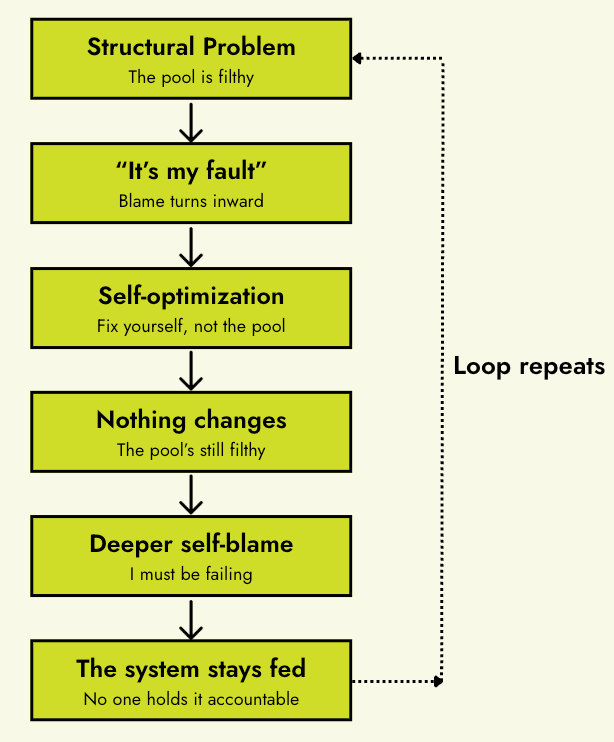
This pattern is effective af.
A pool pump recirculates the same water again and again. That’s what my shame did too. Another day at the company, another issue I diagnosed myself with. It was the same grimy water over and over, but if I scrubbed myself hard enough, that water would finally run clean, right?
So I bought self-help books. I looked up boundaries. I worked out, even more, to reduce my stress. I stopped drinking alcohol, because my margin for error was so low at work. Surely, that would help!! I explored Buddhism. Yoga constantly. Joined Equinox. I thought to myself, I’m taking responsibility. I’m not making excuses.
But every ounce of that energy was pointed back at me or a scapegoat at work. Never at that muddy water.
And my company loved that. While I was drowning in my own shame and blaming others, I didn’t have time to ask why the pool was so gross. Obsessed with proving that I belonged there, leaving was not an option. Naming the culture out loud was too risky. I had already gotten my hand slapped for doing so. Now that I was visibly struggling, naming it was off the table.
So I kept trying to become someone who could finally handle the pressure. I scrubbed myself raw, instead of the pool, over and over. And thanked my company for the opportunity.
This plays out across the board and finds women first.
From the jump, our society tells us that we’re the problem. To apologize for existing. To scrutinize ourselves before asserting needs. We’re socialized to be caretakers, who can fix anything. Once everyone sees what I see, I’ll be seen. Understood. And a hero.
That’s the training talking. But it’s not like it gets any easier when we point out the larger issues.
When we do, we become a threat to the company culture. We start getting attacked, isolated, demoted, etc. Culture course corrects to its blueprint without honest evaluation and the machinery required to actually change.
Women of Color are especially policed and “put in their place” when they point out these issues or try to make things better. Their words and actions are interpreted as insubordination — a direct threat to the most powerful in the room.
Women of Color, especially Black and Indigenous women, are “lower” in the white supremacy hierarchy. They’re expected to apologize, optimize, and sacrifice even more. They’re villainized, labeled “angry.” Penalized twice: once for speaking and again for how they speak.
They have a sharper radar for culture problems, because that radar has had to work harder to help them survive. When a Woman of Color speaks up, we white women too-often watch them get punished and learn to just say: nothing.
In the absence of change, we default to blaming ourselves. When the water runs dirty, the scrub brush is already on our skin, queued to scour.
A workforce made up of women beating ourselves up won’t bother to leave or organize or hold people accountable en masse. It’s focused on blending in as “meets expectations.” Meanwhile, layoffs have become a consequence for nonparticipation in this system.
But it still doesn’t matter if you’re the most optimized, therapized, and boundaried woman alive. You’ll still feel disgusting swimming in a disgusting company culture.
It matters what pool you swim in.

Becoming a cleaner, better swimmer was never the answer. It’s looking for a cleaner, better swimming pool.
Instead of contorting yourself to fit into a bad culture, I want you to look for a better culture.
For me, that meant walking away from tech, contracting work, and starting my own business. Whereas I had to slash my budget big time, the water here is clean. Because I trust the pool girl: me.
I know not everyone can become a solopreneur, but that’s not the point. The point is blaming yourself for your company culture only hurts you further.
So please stop hurting yourself.
It was always the water.